
Consciência·9 min read
Looking Up: Psalm 8 and the Art of Contemplation
Contemplating creation in Psalm 8 and Matthew 6: what it means to look at the sky, the birds and the lilies, and what attention and nature research actually measured.
Before reading further
Back to the LibraryA question to accompany your reading
What would you like to understand about “Looking Up: Psalm 8 and the Art of Contemplation”?+Explore the starting point
Contemplating creation in Psalm 8 and Matthew 6: what it means to look at the sky, the birds and the lilies, and what attention and nature research actually measured.
Start readingChoose where to enterIn this essay +6 parts to explore
Environment
Find your rhythm
Nature sounds
Optional. The soundscape is synthesized and becomes quieter during speech.
Following the landscape: River
Landscape motion
Pause the moving image without interrupting sound or reading.
Your reading
Listening options
Listening room
Let the words meet your attention.
Listen to the essay, choose a movement, or return to reading whenever you wish.
Checking device voices…
Synthetic reading with local voices exposed by your browser. Your notes are excluded. Quality and availability depend on your device; this version does not offer downloadable audio.
Have you ever spent a whole queue looking at your phone and, putting it away, realized you had seen nothing of the place you were standing in? Not the face of the person next to you, not the colour of the evening in the window. Nobody meant any harm. The screen was there, the hand moved on its own, and the minutes went by.
This happens to many people, and it is no reason for shame. But it leaves a gentle question: when did I last look at something just to look, with no photo, no hurry, wanting nothing from it? This text is not an order to put screens down. It is an invitation to remember something very old: looking at the world, really looking, is also a way of thinking and of praying.
Looking is not the same as seeing
Seeing happens by itself. Looking is an act: a person chooses to rest their attention on something and stay a little. The word "contemplate" comes from that gesture. To contemplate is to look calmly and with wonder, letting the thing say what it has to say instead of already hunting for what to do with it.
The Bible is full of people who look. Psalm 19:1 says the heavens tell the glory of God. The wisdom writers of Israel send the lazy person to learn from the ant (Proverbs 6:6). Jesus taught with seeds, sheep, birds and flowers, things people saw every day and, from seeing so often, hardly looked at any more. What do the sky, the birds and the lilies have in common? They cost nothing, they depend on no one, and they are within reach of anyone who lifts their head.
Why we look so little today is a question other texts in this house have already taken up, under the heading of the contest for our attention. Here the focus is different: what is gained when attention, for a few minutes, comes to rest on something that is asking nothing of us.
Psalm 8: the sky, the moon and the question
Psalm 8 is a good place to learn to look. It is short, and almost all of it is a gaze that turns into a question.
What the text says. Psalm 8 is a song, ascribed to David in the heading that opens it. From what it describes, the speaker stands under the night sky. Verses 3 and 4 (4 and 5 in Bibles that count the heading) say, in paraphrase: when I look at your heavens, the work of your fingers, at the moon and stars you set in place, I ask what a human being is that God should remember him, what a mortal is that God should care for him. The psalm begins and ends with the same praise, about how great God's name is in all the earth (verses 1 and 9).
The answer comes right after. According to the psalm, God made human beings a little lower than "heavenly beings" and crowned them with glory and honour (verse 5). And he made them rule over the works of his hands: sheep, oxen, wild animals, birds and fish (verses 6 to 8).
What it means. Three points help us read it faithfully.
First, the question is one of wonder, not of contempt. The poet does not feel thrown away by the size of the sky. He is amazed that, before such immensity, God pays attention to people. Wonder is the centre of the psalm.
Second, the phrase "a little lower than heavenly beings" is hard. The Hebrew uses elohim, a word that can mean God, gods or beings of heaven. Some Bibles translate it "angels", and the letter to the Hebrews (2:6–8) quotes the psalm that way, from the ancient Greek translation. Scholars discuss how to read it, and Christian tradition reads it in more than one way. The main point is clear even without settling the detail: the human being has a place of honour, given and not earned.
Third, this rule echoes Genesis 1:26–28, where humans are made in God's image. Many scholars read it as care, not ownership: in the ancient world, whoever represents the king looks after what is the king's, as the king would. That is why the psalm ends in praise and not in pride. What we have received is not ours by our own right.
What changes in life. As an application, and not as something the psalm says about our own time: the question "what is a human being?" works in both directions. Under the sky, we feel small. And at the same time the psalm says someone sees us. Whoever looks at the sky with this wonder can come back with humility and worth at the same time. And this holds for anyone, whether their faith is firm, doubtful, or not yet there.
The birds and the lilies: looking in order to learn
In the Sermon on the Mount, Jesus also tells people to look. The scene is Matthew 6:25–34, and it matters to see whom he is speaking to.
What the text says. Jesus speaks to disciples, with the crowd nearby, about worry over food, drink and clothes. He says: look at the birds of the sky, which do not sow or reap, and your heavenly Father feeds them (Matthew 6:26). And then: learn from the lilies of the field, which do not toil or spin, yet not even Solomon in all his wealth was dressed like one of them (Matthew 6:28–29).
What it means. The verb he uses for the lilies means something like "observe well, learn with attention". It is not a passing glance. Exactly which flower he meant, the text does not say; Galilee had many wildflowers, and scholars do not agree on one answer. The meaning matters more than the species.
The teaching is also easy to misread. Jesus is not saying that nobody should work or plan; the New Testament itself speaks well of work. What he touches is the worry that consumes. The birds and the flowers are a lesson in trust, and the lesson only works for those who take the trouble to look. Whoever rushes by gets the information but does not learn.
What changes in life. As an application: the text invites us to set a worry aside now and then to look at something alive. A bird on a wire, a plant on the pavement, the sky between two buildings. The invitation is not a trick to make problems vanish. It is a way of remembering that life is larger than today's list, and that there is a care older than all our efforts.
What the research measured, and what it did not
There are also studies on the effect of looking at nature. It is worth knowing what they actually did.
One of the most quoted ideas is "attention restoration theory", proposed by the psychologists Rachel and Stephen Kaplan. In The Experience of Nature (1989) and in a 1995 article by Stephen Kaplan in the Journal of Environmental Psychology, they argue that directed attention gets tired, and that natural settings, because they hold attention without effort (clouds, leaves, water), may help the mind rest from that strain.
A well-known test is the one by Marc Berman, John Jonides and Stephen Kaplan, published in 2008 in Psychological Science. University students did a short-term memory task (repeating number sequences backwards) and then walked for 50 to 55 minutes, once in a tree-filled park and, a week later, along busy downtown streets. Coming back from the park, their improvement on the task was greater than coming back from the city. In a second experiment, about ten minutes of looking at photographs of nature, rather than of the city, brought a similar improvement.
The limits matter. The groups were small (38 students in the first test, 12 in the second). What was measured was one kind of attention and memory task, soon after the walk, and not "inner life", "wisdom" or "closeness to God". A review of 31 studies by Ohly and colleagues (2016) found some support on three memory and attention tasks, but not on the others, and pointed to small studies that differed a great deal from one another. In other words: there are good signs that looking at greenery helps attention, and how much, why, and for whom is still debated.
One more caution: none of these studies is about contemplation in the sense of Psalm 8. The psalmist did not look at the sky to concentrate better. He looked and was amazed. At most, research can give us one more reason not to think that looking at the sky is wasted time.
One small step
Instead of a conclusion, a simple question: what could I look at today, for two or three minutes, doing nothing else? It could be the sky from a window, a tree on the street, someone playing. If you like, read Psalm 8 in a low voice before or after. And if the psalmist's question comes, "what is a human being?", it can simply stay there, with no hurry to answer.
There is no right way to do this, and no scoreboard. If today did not work out, tomorrow the sky will be in the same place.
Readings
- Bible: Psalm 8; Psalm 19:1; Genesis 1:26–28; Matthew 6:25–34; Proverbs 6:6; Hebrews 2:6–8.
- The Experience of Nature: A Psychological Perspective, by Rachel Kaplan and Stephen Kaplan, Cambridge University Press, 1989.
- "The restorative benefits of nature: Toward an integrative framework", by Stephen Kaplan, Journal of Environmental Psychology, 1995.
- "The cognitive benefits of interacting with nature", by Marc G. Berman, John Jonides and Stephen Kaplan, Psychological Science, 2008.
- A systematic review of attention restoration theory, by Heather Ohly and others, Journal of Toxicology and Environmental Health, Part B, 2016.
From reading into life
From reading to lifeStudy deskMake room for what this text awakened. You can simply reflect, or write.
The notebook needs JavaScript to edit and save notes. You can continue reflecting with these questions.
Understand
Which idea deserves a closer look? What question or source would you like to investigate?
Contemplate
What does this reading reveal about the way you live, love, or seek the truth?
Live
What concrete gesture could grow from this reading, in caring for yourself or someone else?
Stays only in this browser. It is not sent to anyone or to an AI. If you clear your browser data, the notes are gone.
Keep in touch with Brotherhood
An open door
Continue this search with Brotherhood.
If you would like to leave your contact details to stay connected with Brotherhood, register your email. You can also keep exploring the library freely.
How we care for your dataFrom understanding into life
What does this reading change in your perspective?
Return to “Looking Up: Psalm 8 and the Art of Contemplation” in two ways: explain what you understood and consider a concrete situation.
Explain it in your own words+
Choose an idea from “Looking Up: Psalm 8 and the Art of Contemplation”. How would you explain it to someone? Distinguish what the text claims, the basis it offers and your own interpretation. Note anything that remains unclear.
Open the reflection notebook ↗Connect it to a real situation+
Think of a situation where an idea from “Looking Up: Psalm 8 and the Art of Contemplation” might be useful. What would change? What limits or questions would you need to consider before acting?
Open the reflection notebook ↗The next mystery
To go deeper
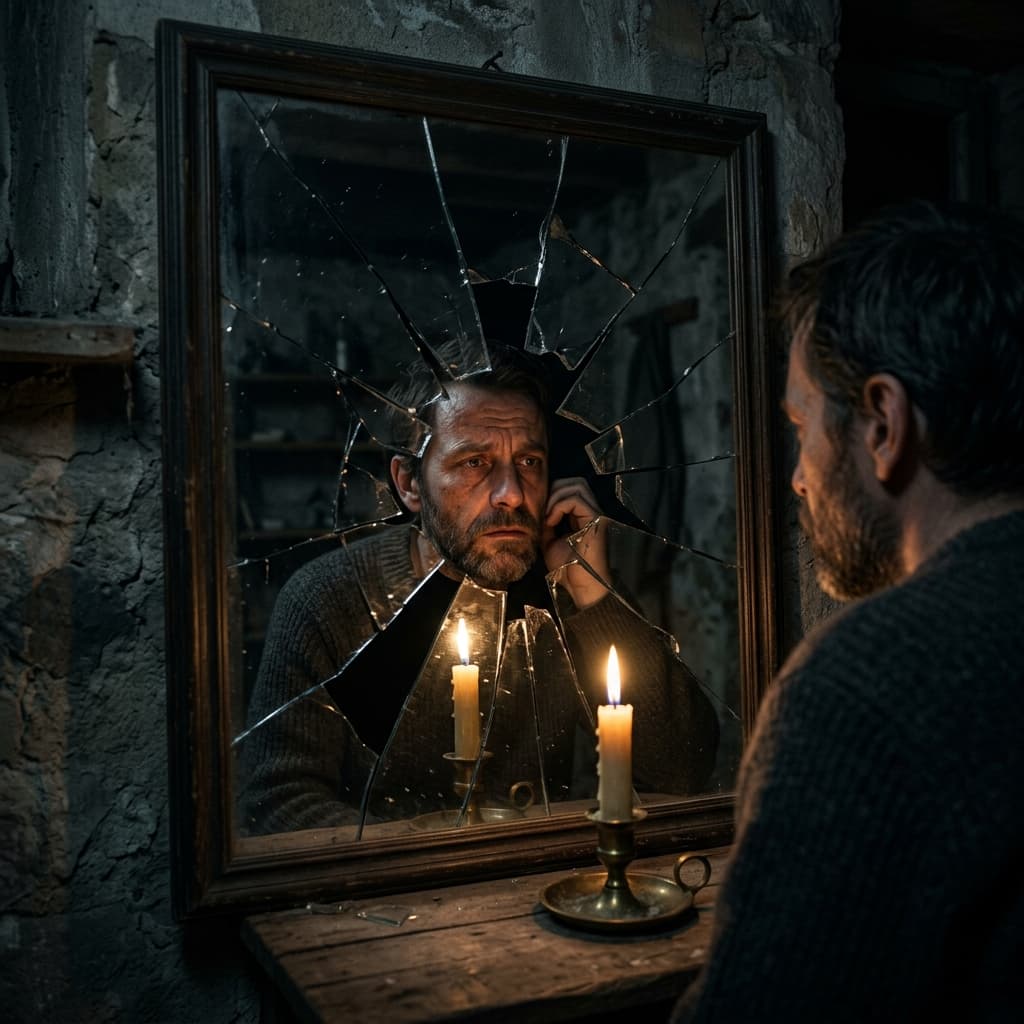
Coming to Yourself: Conscience and the Way Home
Conscience as a gift rather than a guilt alarm: Psalm 139 and the parable of the returning son in Luke 15, on repentance as a way home.
Enter
From Darkness to Light: Waking Up in Ephesians 5
Ephesians 5:8–14 and the call to "wake up, sleeper": living on autopilot, the light that comes from Christ, and waking as a path walked together.
EnterThe Dialogue Continues
Wisdom is consolidated through exchange. Join the Brotherhood to participate in the discussion on this tome.
Join the Brotherhood